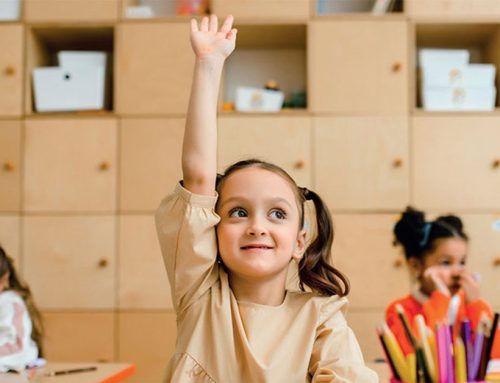
 A child’s mind is moldable and “spongy.” By spongy, I mean that it has the ability to easily absorb the stimuli received. The mind's expanding neurons create a circuit of powerful connections that will forge mental structures. Children's characters, intelligence, and feelings will be conditioned by how, from an early age, the children learn to respond to their external environment. If you provide stimuli capable of capturing a child’s ability to be attentive, powerful cognitive processes will be triggered, which will lead to learning quickly and productively. It has also been proven that learning is greatly conditioned by emotional aspects. In some children, a slow intellectual development is often a symptom of emotional distress, due to a problem within the family environment or to a trauma. On the other hand, children who grow up in a loving and stimulating environment will develop their minds with great speed, so that learning and discovering new things will bring them enormous gratification and provide a great basis for social and intellectual development in the future. Children with a healthy intellectual and emotional structure know how to express their own opinions, analyze things on their own, and see situations from several points of view.
Home should be a mentally and spiritually stimulating place for children. A stimulus attracts and activates the individual. Admittedly, the traditional method of 'frontal lobe' learning (blackboard, teacher, memorization) has not been proven to be the most attractive or stimulating method. For many children with ready minds, a rigid and static environment can become a real torture. Psychological problems such as low concentration and hyperactivity, as well as social problems such as poor education or disinterest in classes, are often diagnosed, when the same child with an environment more adapted to his or her character could surprise us with increased learning ability, proactivity, and enthusiasm. At this point the following questions arise spontaneously: Are my children receiving the most effective stimuli for their development? Based on their particular characteristics, in what way can we attract and further develop their love for learning? According to age and personal development, children often need to make substantial use of the senses to assimilate the world. Therefore, they need to touch, get dirty many times (do not hate me, mothers!), smell, look, and even taste to learn and develop themselves.
The best environment for mental and spiritual development is nature itself. Teaching a child to discover natural phenomena and to experience in the first person (watching, creating, participating) the natural processes opens a world of knowledge. Of course, encyclopaedias describe natural wonders, but books are not the first step. The encyclopaedia will be somewhat 'arid' for a child who has not breathed the scent of the meadow, learned to distinguish the songs of the birds, touched the snow, or seen an insect with the microscope. When children have had these experiences, they will internalize them and develop the ability to read and understand a book, as if they could visualize what is written. This is a very high level of intellectual development, but every child can reach it. That is why I urge all parents to let themselves be carried away by imagination, and to imbue themselves with the enthusiasm of a children, in order to travel with them in the exciting world of learning. I will give you some ideas that I hope are stimulating; nonetheless, I am sure that each parent will know how to find the perfect key to intrigue and stimulate their children. Here are some simple tips:
- Dedicate a space in the house for the storage of materials (papers, scissors, regular and hot glue, card stock, magazine cut-outs, newspapers, and so on) with which children can undertake activities while listening to pleasant music and wearing casual clothes.
- Set aside time to spend with the children. It may seem the most obvious advice but, unfortunately, nowadays it is not. We are immersed in so many activities (and children are too!), that it's hard to stop and look at each other, to simply “be there” and be comfortable together. When this habit is acquired, we realize that the effort put into following this routine is truly worth it the effort, because in the end we all feel happier. Sometimes you do not have to do complicated things or spend many hours together. Quality time is very rewarding.
- On the days with good weather, go outside! Nature is full of surprises! Organize a treasure hunt, build a wooden hut, discover nests, or dig up some dirt, filter it, and create clay to make shapes, then paint them. With a crayon draw the shape of a leaf on a sheet of paper, write in the exploring child's notebook the sounds that can be heard when standing quietly in the middle of the trees, follow animal tracks, pick up pine cones or chestnuts and paint them, make a picture with autumn leaves and their different colours.... There is a world of possibilities!
- To teach subjects such as history or geography, imagination is also a powerful ally. You can build a time machine with a few materials. With it, you can travel to the time and place you want. Simply hang up a bed sheet and place on one side a panel with numbers on which to enter the “data,” and then put on the other side old dresses or objects that take children to a specific time and place (crowns for queens or kings, Indian outfits, feathers, binoculars to discover a new world in the distance, etc.). From then on, it will be easy to open a laboratory on the subject to discover more about a country or a historical epoch.For example, to learn the history of India, you could wear colorful clothes, tell interesting facts about the place, show pictures, listen to oriental music, and even finish by tasting typical ethnic foods! You will see that, after this, reading a book on the subject will be much easier and more interesting. The same goes for learning physics or astronomy. Creating planets with play dough and hanging them in the play zone, while observing the different sizes and colors, or visiting a planetarium, is much different than sitting quietly in a library and learning the planets by heart.
- The last but not the least important tip is to encourage children to have their own private devotional time every morning and evening—in addition to family worship. Encourage your children to research, on their own, the many facets of the precious gems of the Bible, and to share them with the rest of the family. Their ability to develop an idea and internalize it is fundamental to their spiritual development.
Dear brothers and sisters, I hope that these simple tips will encourage and be a blessing to for you. May the Lord be with us all and bless us in this solemn and precious work. I will close with this reassuring verse in Proverbs 22:6. “Start children off on the way they should go, and even when they are old they will not turn from it”.
By Yurena Trujillo Pérez (Italy)